

The Hero’s Journey is a classic storytelling framework that has been used for centuries to create compelling narratives. It involves a hero who embarks on a journey, faces challenges, undergoes transformation, and returns with newfound wisdom. This structure can be effectively applied to business presentations to create engaging and impactful stories. This article explores how to use the Hero’s Journey framework in business presentations and provides practical tips for structuring your story for maximum impact.
Understanding the Hero’s Journey
The Hero’s Journey framework, first articulated by Joseph Campbell, a mythologist whose work explored universal story patterns across cultures, provides the foundational structure behind this model and its twelve stages of transformation.
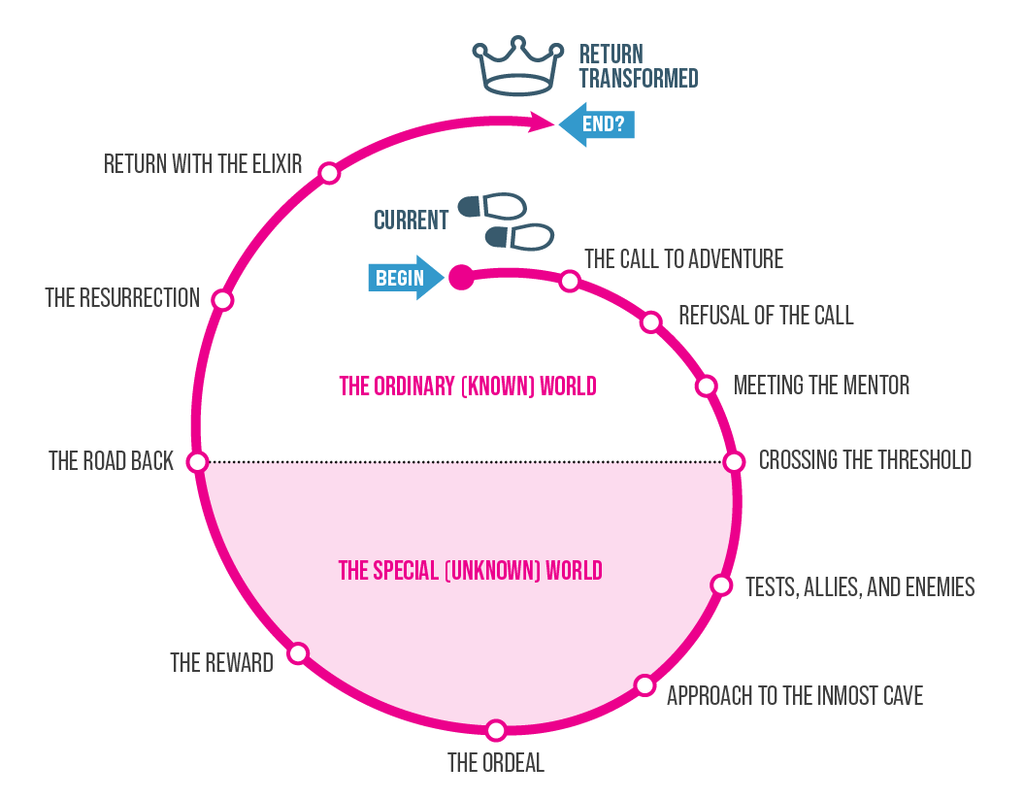
Caption: Based on Joseph Campbell’s Hero’s Journey framework, shown here as a progression that emphasizes commitment, challenge, and return transformed.
Applying the Hero’s Journey to Business Presentations
In business presentations, structure matters as much as content. Clear narrative arcs help audiences stay oriented, understand what is changing, and follow ideas from problem to resolution, a principle long emphasized by communication experts such as Nancy Duarte. In this context, the “hero” represents the person, product, or organization navigating change.
1. The Ordinary World
Begin your presentation by setting the stage and describing the current situation. This is the “ordinary world” where everything is as it is before the journey begins.
Tips:
- Provide context for your audience by describing the current state of affairs.
- Use visuals and data to illustrate the ordinary world.
- Relate the ordinary world to the audience’s experience to create a connection.
2. The Call to Adventure
Introduce the challenge or opportunity that prompts the journey. This is the “call to adventure” that sets the story in motion.
Tips:
- Clearly define the challenge or opportunity.
- Explain why it is significant and why it matters to the audience.
- Use data, examples, or anecdotes to illustrate the call to adventure.
3. Refusal of the Call
Acknowledge any hesitation or resistance to the call. This adds tension and makes the story more relatable.
Tips:
- Describe any initial doubts or obstacles.
- Explain why the call might be refused or resisted.
- Use real-world examples or anecdotes to illustrate the refusal of the call.
4. Meeting the Mentor
Introduce the mentor who provides guidance and support. This could be a person, a tool, or a strategy.
Tips:
- Describe the mentor’s role and how they provide guidance.
- Use visuals or examples to illustrate the mentor’s impact.
- Relate the mentor to the audience’s experience to create a connection.
5. Crossing the Threshold
Describe the moment when the hero commits to the journey and leaves the ordinary world. This is the “crossing the threshold” stage.
Tips:
- Highlight the decision to commit to the journey.
- Use visuals and data to illustrate the crossing of the threshold.
- Explain the significance of this moment and its impact on the journey.
6. Tests, Allies, and Enemies
Describe the challenges, allies, and enemies the hero encounters along the way. This adds depth and complexity to the story.
Tips:
- Highlight key challenges and obstacles.
- Introduce allies who provide support and enemies who create conflict.
- Use visuals, data, and examples to illustrate these elements.
7. Approach to the Inmost Cave
Describe the approach to a significant challenge or crisis. This is the “approach to the inmost cave” stage.
Tips:
- Highlight the build-up to the significant challenge.
- Use visuals and data to illustrate the approach.
- Explain the significance of this moment and its impact on the journey.
8. The Ordeal
Describe the greatest challenge or obstacle the hero faces. This is the “ordeal” stage and is the climax of the story.
Tips:
- Highlight the key challenges and obstacles.
- Use visuals, data, and examples to illustrate the ordeal.
- Explain the significance of this moment and its impact on the journey.
9. The Reward
Describe the reward or victory the hero achieves. This is the “reward” stage.
Tips:
- Highlight the key achievements and outcomes.
- Use visuals, data, and examples to illustrate the reward.
- Explain the significance of this moment and its impact on the journey.
10. The Road Back
Describe the journey back to the ordinary world. This is the “road back” stage.
Tips:
- Highlight the return journey and any remaining challenges.
- Use visuals and data to illustrate the road back.
- Explain the significance of this moment and its impact on the journey.
11. The Resurrection
Describe the final test and transformation the hero undergoes. This is the “resurrection” stage.
Tips:
- Highlight the final test and transformation.
- Use visuals, data, and examples to illustrate the resurrection.
- Explain the significance of this moment and its impact on the journey.
12. Return with the Elixir
Describe the hero’s return with newfound wisdom or a reward. This is the “return with the elixir” stage and the conclusion of the story.
Tips:
- Highlight the key takeaways and lessons learned.
- Use visuals, data, and examples to illustrate the return with the elixir.
- Relate the return with the elixir to the audience’s experience and goals.
Practical Tips for Using the Hero’s Journey in Business Presentations
- Identify the Hero: The hero of your story could be your company, a product, a customer, or even the audience. Identify the hero and build your narrative around their journey. Storytelling practitioners such as Michael Margolis, who works with leaders to use narrative as a decision-making tool, reinforce the idea that audiences engage more deeply when they recognize themselves inside a clearly defined journey.
- Use Visuals to Enhance the Narrative: Visuals are crucial for bringing the Hero’s Journey to life. Use images, videos, infographics, and data visualizations to illustrate each stage of the journey.
- Incorporate Emotion: Emotion is a powerful tool in storytelling. Use techniques such as personal anecdotes, relatable examples, and vivid descriptions to evoke emotions and create a deeper connection with the audience.
- Practice Your Delivery: The way you deliver your story is as important as the content itself. Practice your delivery to ensure a smooth and engaging presentation.
- Engage Your Audience: Encourage interaction by asking questions, inviting feedback, or incorporating interactive elements. This can make your presentation more dynamic and engaging.
Examples of Successful Use of the Hero’s Journey in Business Presentations
Many successful presentations borrow from cinematic storytelling, where emotional pacing and clear narrative progression help audiences stay engaged. Storytellers like Matthew Luhn, who transitioned from Pixar filmmaking to advising organizations, have shown how these same principles translate effectively into business communication.
1. Steve Jobs’ Product Launches
Steve Jobs often used the Hero’s Journey framework in his product launches. He would introduce a challenge or opportunity (the call to adventure), describe the initial resistance and guidance (refusal of the call and meeting the mentor), highlight the key challenges and obstacles (tests, allies, and enemies), and celebrate the product’s success (the reward).
2. Customer Success Stories
Many companies use the Hero’s Journey framework to tell customer success stories. They introduce the customer’s initial challenge (the call to adventure), describe the journey and key obstacles (tests, allies, and enemies), highlight the solution and success (the reward), and explain the impact on the customer’s business (return with the elixir).
3. Marketing Campaigns
Marketing campaigns often use this framework to create compelling narratives. They introduce a challenge or opportunity (the call to adventure), describe the journey and key obstacles (tests, allies, and enemies), highlight the solution and success (the reward), and explain the impact on the audience (return with the elixir).
Conclusion
The Hero’s Journey is a powerful storytelling framework that can be effectively applied to business presentations. By following the stages of the Hero’s Journey, you can create engaging and impactful stories that captivate and inform your audience. Focus on setting, characters, conflict, plot, and resolution, define your purpose, know your audience, create a story arc, use visuals to enhance the narrative, and incorporate emotion. Start applying the Hero’s Journey framework to your presentations today to elevate your communication skills and deliver impactful messages.